Sensible Forecasting is one of the few inventory apps I would recommend without a caveat about complexity. It works out what to reorder and emails you when something needs attention, and that is most of the job. The part it leaves you is raising the purchase order, sending it, and tracking what is on its way. This page is about whether that part matters to you.
Written 26 August 2026. Every claim below about Sensible was checked that day against its Shopify App Store listing, its own site and its own pricing FAQ. Those pages change, and a comparison page written by a competitor ages badly. Check them yourself before you decide anything.
Sensible Inventory Forecasting has been on the Shopify App Store since 8 February 2024. It holds 4.5 stars from 9 reviews and carries the Built for Shopify badge. One plan, $29 a month, 30-day free trial, unlimited products and unlimited SKUs, no tiers and no usage limits.
It reads your sales history over a window you pick, 14, 30, 60 or 90 days or a weighted average, works out how fast each product sells, and turns that into a reorder quantity. You can set lead time, safety stock and days of stock per product. You can attach several vendors to one product and filter the reorder list by supplier. Once a week it emails you a status report. You export the result as CSV or XLSX.
Two of those things are in Proviand because Sensible did them first and did them well, and I want to say that out loud rather than bury it.
The reviews are consistent about one thing above all: the people behind it answer you. Eight of the nine are five stars and several name the responsiveness directly, including one merchant who says an integration was built so their bundles would be counted. That is a real advantage and no feature list captures it.
Their pricing FAQ puts it plainly, and I am quoting rather than characterising: "Sensible Forecasting doesn't create purchase orders inside Shopify. Instead, you can export your reorder recommendations as CSV or Excel and send them directly to your supplier."
That is an honest description of a boundary, not a flaw. The question is what it means on the Monday you actually order. Here is the work that sits on your side of the line:
None of that is hard. It is about twenty minutes per supplier per cycle, plus the memory. The memory is the expensive part. Ordering the same thing twice because the first order was invisible to the forecast is the single most common way a small store loses money on inventory, and a spreadsheet held outside the app is exactly where that gap lives.
Proviand's buying table is the same idea as Sensible's reorder list. What changes is what you can do with a row.
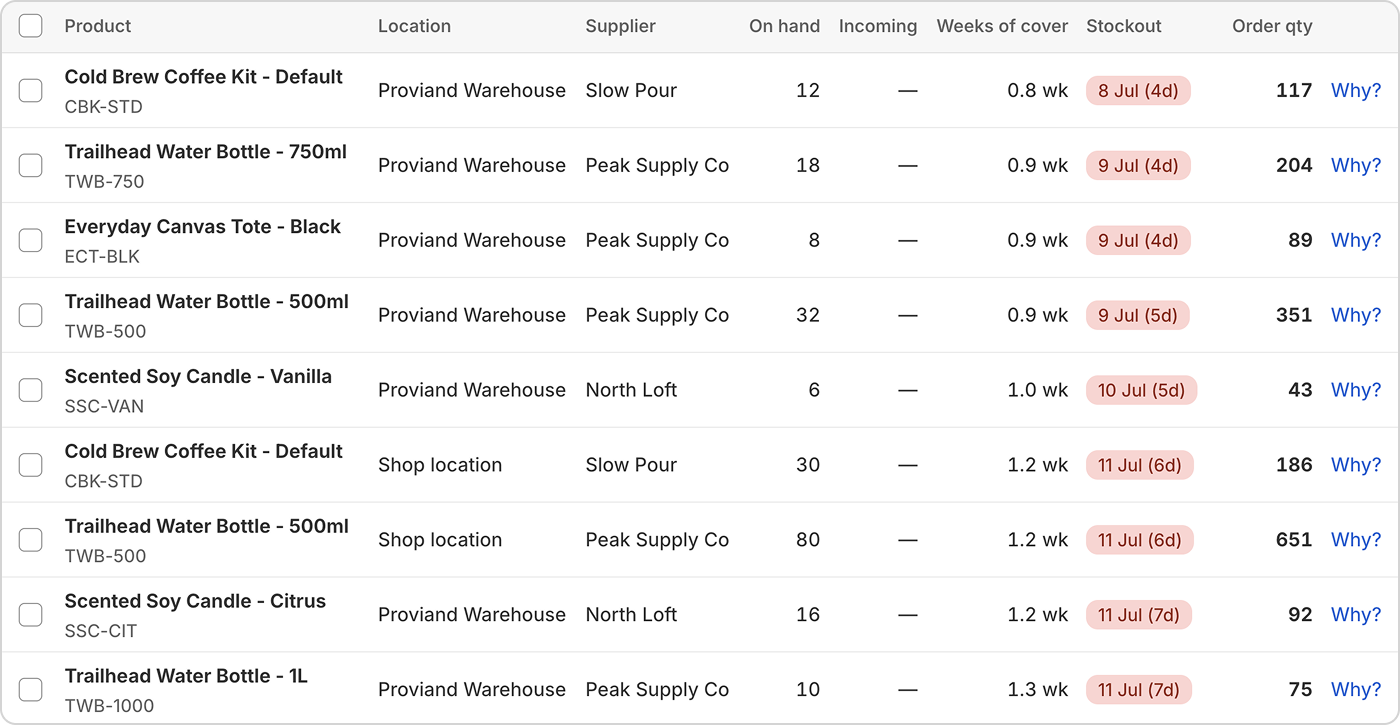
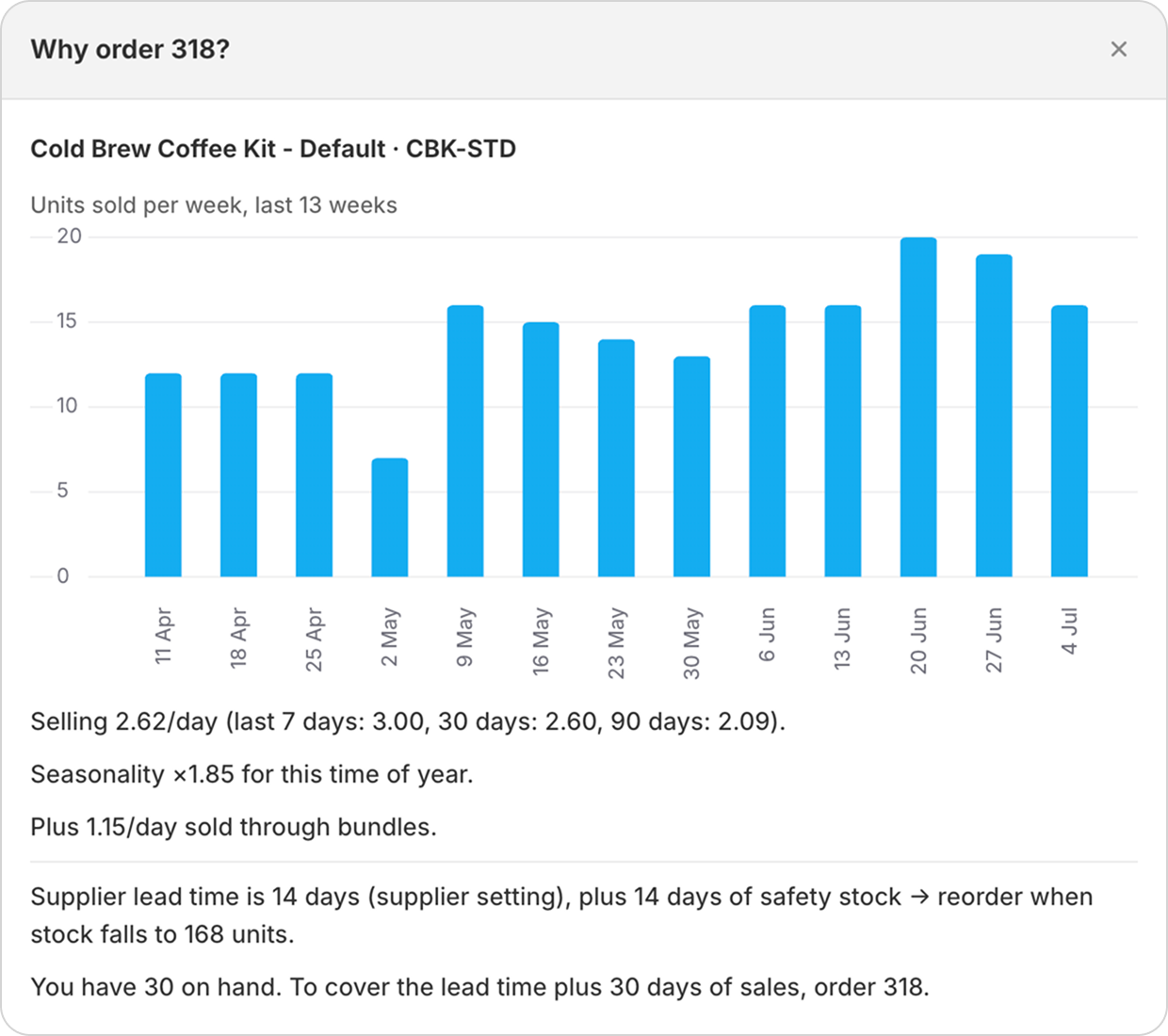
Every recommendation opens up to show the arithmetic that produced it: average demand, lead time, safety stock, units already incoming, and the order quantity that falls out of them. If you disagree with the number, you can see which input to argue with.
From there you select the lines, and Proviand groups them into one purchase order per supplier and emails it out. The order then exists as a record: it is open, it has a supplier and an expected date, and its units count as incoming, so the next forecast already knows about them.
When the delivery lands you receive against the order, including short deliveries.


Receiving writes the stock into Shopify, so the count you trust and the count you sell from are the same count. That is the whole difference between the two apps, and it is worth being precise about it: Sensible tells you what to buy, and Proviand also carries the order from decision to shelf.
You will read elsewhere that Sensible is single-location. As of today that is out of date. Their FAQ says multi-location support is available as a beta feature and asks you to contact support to switch it on. If you run two locations, ask them where the beta stands before you rule them out on it.
Proviand's position is not automatically better. Multiple locations start on Pro at $49 a month, ten of them, with unlimited locations on Plus at $99. Free and Starter are one location. So for a two-location store, Sensible's beta at $29 may well be the cheaper answer, and the trade you are making is beta versus a higher tier.
Sensible is $29 a month, one plan, unlimited SKUs, 30-day trial. Proviand:
Annual is two months free, paid plans have a 14-day trial, and everything bills through the Shopify Billing API so it lands on the Shopify invoice you already pay. Read the SKU caps carefully, because that is where the two prices stop being comparable. At the same $29, Sensible has no SKU limit and Proviand stops at 2,000. If you carry 6,000 SKUs, Sensible is $29 and Proviand is $49.
One thing to check before you buy either. A three-star review from August 2026 reports support going quiet and the app not working. It is the only negative review on the listing against eight five-star ones, and their site and pricing pages were up when I checked them on 26 August 2026. Still, support is the thing merchants praise Sensible for, so email them a question during the trial and see how fast the answer comes. Do the same to me.
Proviand launched this summer, it has no review history, and it is built and maintained by one person. Count that as a risk rather than waving it away. It reads Shopify and nothing else: no marketplaces, no wholesale channel, no 3PL. It does no stock transfers between locations, no warehouse counts, no cash-flow or open-to-buy planning, and it has no report builder or approval workflow. If two people have to sign off a purchase order, it will not model that.
What it does is read your Shopify sales history, tell you what to order today and exactly why, and carry that order out to the supplier and back into your stock count. If that is the whole job, the small surface area is the point. If it is a third of the job, it is a gap, and Sensible plus your own spreadsheet may be the better fit at a lower price.
Both have a free way in, so do not decide on a feature table. Sensible gives you 30 days. Proviand's free plan has no time limit at all, and it reads the order history already sitting in your store, so the buying table is populated the same afternoon.
Install one, or both, and wait until the next time you actually have to place an order. Then count the minutes between opening the recommendation and the order being sent, and count how many times you had to write a number down somewhere else. That is the only comparison that has ever told anyone anything useful.
Not sure which fits? Email [email protected] with how many SKUs you carry, how many suppliers you buy from and how you send orders today. If the answer is Sensible I will tell you.