That is the whole comparison, and everything else on this page is arithmetic on top of it. Prediko is a capable planning system aimed at brands that are already buying at volume across suppliers, locations and raw materials. Proviand answers a smaller question: what should I reorder this week, why that number, and can it go out as a purchase order without leaving the app. Which one fits is a question about your stage, not about which team writes better software.
Written 26 August 2026. Every claim below about Prediko was checked that day against its Shopify App Store listing and its own pricing page at prediko.io. Prediko publishes its own comparison content and moves quickly, so those pages will have changed by the time you read this. Check them yourself before you decide anything.
Prediko Inventory Management has been on the Shopify App Store since 11 August 2023. As of today it holds 4.9 stars from 233 reviews, which is the strongest review record of any app in this category that I have looked at, and 224 of those are five stars.
Read the reviews and the same two things come back. Merchants call it a real replacement for Stocky rather than a partial one, and they name the people. A merchant two days into the app in August 2026 is already talking about supplier data being imported for them. A merchant five months in says the team actually ships the feedback they give. Personalised onboarding, a dedicated success manager and a private Slack channel are listed on every paid tier, which is why those reviews read the way they do. That is a deliberate product decision and it works.
The feature surface is genuinely broad. AI demand forecasting by product, SKU and season. Purchase order management with buying alerts, including a documented migration path off Stocky. Raw materials and bill-of-materials forecasting, sold as a $20 a month add-on. Multi-location inventory and transfers between locations. Stock takes and barcode labelling. More than twenty customisable reports. Multi-store support, full API access and WMS integrations.
Several of those are things Proviand does not do at all, and I will list them plainly further down rather than leave you to work it out.
Here is the question I would ask before looking at either app. When you sit down to buy, how many decisions are you actually making?
At roughly 200 SKUs from a handful of suppliers, buying is a weekly list. You want to know what is running out, how many to order, and you want the order sent. The hard part is not analysis; it is remembering what is already in transit so you do not order it twice. A planning system with twenty reports does not make that Monday shorter, because you were never going to open nineteen of them.
At 5,000 SKUs across several locations, with components you buy separately from the finished goods you sell, buying stops being a list and becomes a plan. You need to see demand by season, model what a container arriving late does to three months of cover, transfer stock between warehouses, and count physical inventory against the system. At that point the reports are the job. That is the store Prediko is built for, and it earns its price there.
The trap is assuming you will grow into the bigger tool and should buy it early. Capability you never open still costs you the monthly charge and the onboarding you sat through. The opposite trap is real too: if you are already doing raw-materials planning in a spreadsheet, a simpler app will not rescue you.
Prediko's tiers are banded by store revenue. From its App Store listing, checked 26 August 2026:
Unlimited users, SKUs, purchase orders and alerts on every tier, 14-day trial, and two months free on annual billing. One thing worth knowing before you compare: prediko.io shows twelve revenue brackets going up past $10M, and prints a price for only the first one. If your revenue puts you above the bands listed on the App Store, the number you will pay is a conversation, not a published figure. Ask for it early.
Proviand bands by SKU count instead:
Two different axes, so run your own numbers rather than mine. A store doing $80k on 6,000 SKUs pays $49 on Prediko's Starter and $49 on Proviand's Pro, and the deciding factor is features, not price. A store doing $600k on 200 SKUs pays $199 on Prediko's Growth and $29 on Proviand's Starter, because SKU count is what Proviand meters and that store barely uses it. Reverse it and the arithmetic reverses: a low-revenue store with a huge catalogue is cheap on Prediko and expensive on Proviand.
Neither axis is the correct one. Revenue banding means the price tracks what the app is worth to you; SKU banding means it tracks how much work the app is doing. Pick the one that describes your store honestly, then check the number.
Straight list, no softening. Proviand does no raw materials or bill-of-materials planning, no stock transfers between locations, no stock takes or barcode labelling, no multi-store, no WMS or 3PL integrations, no public API, no report builder and no approval workflow. It reads Shopify and nothing else: no marketplaces, no wholesale channel. There is no dedicated success manager, because there is one person here. If two people have to sign off a purchase order, it will not model that.
It also launched this summer and has no review history to speak of, against Prediko's two years and 233 reviews. Count that as risk rather than waving it away.
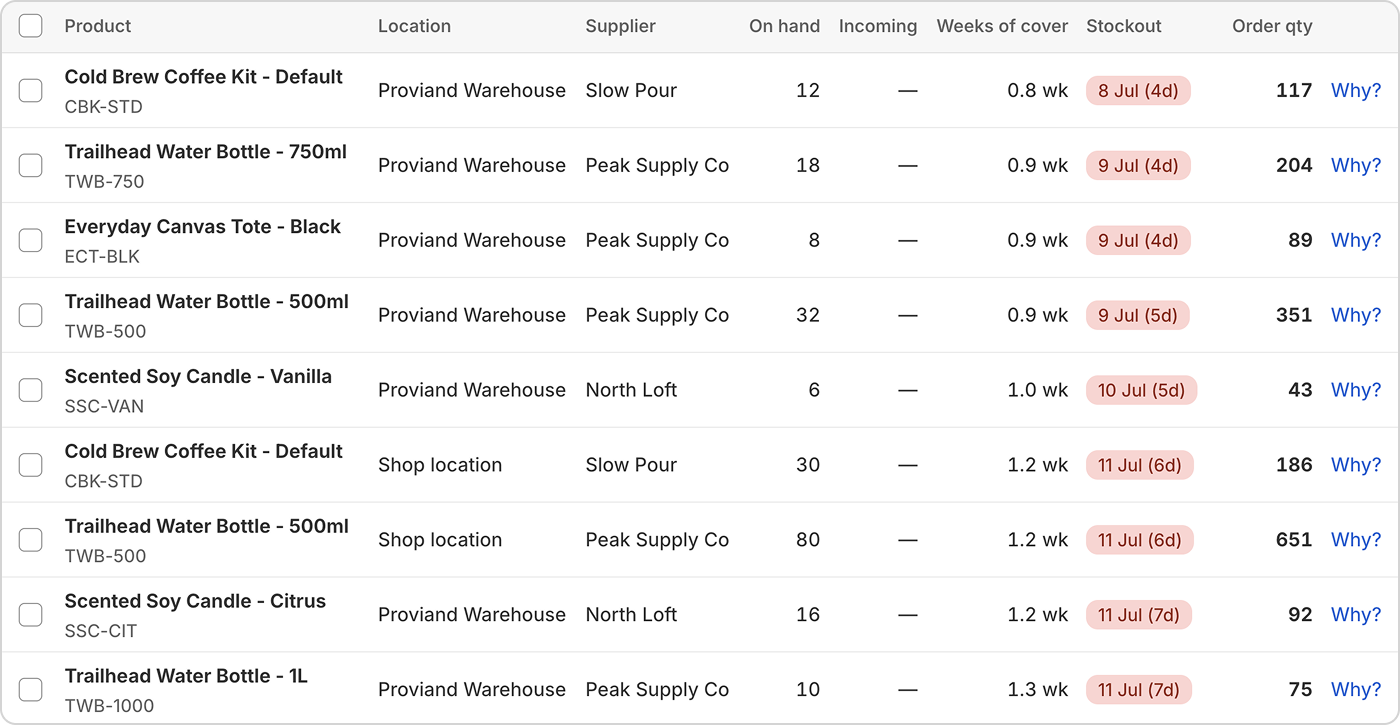
One buying table. Every row is a product with a recommended order quantity.
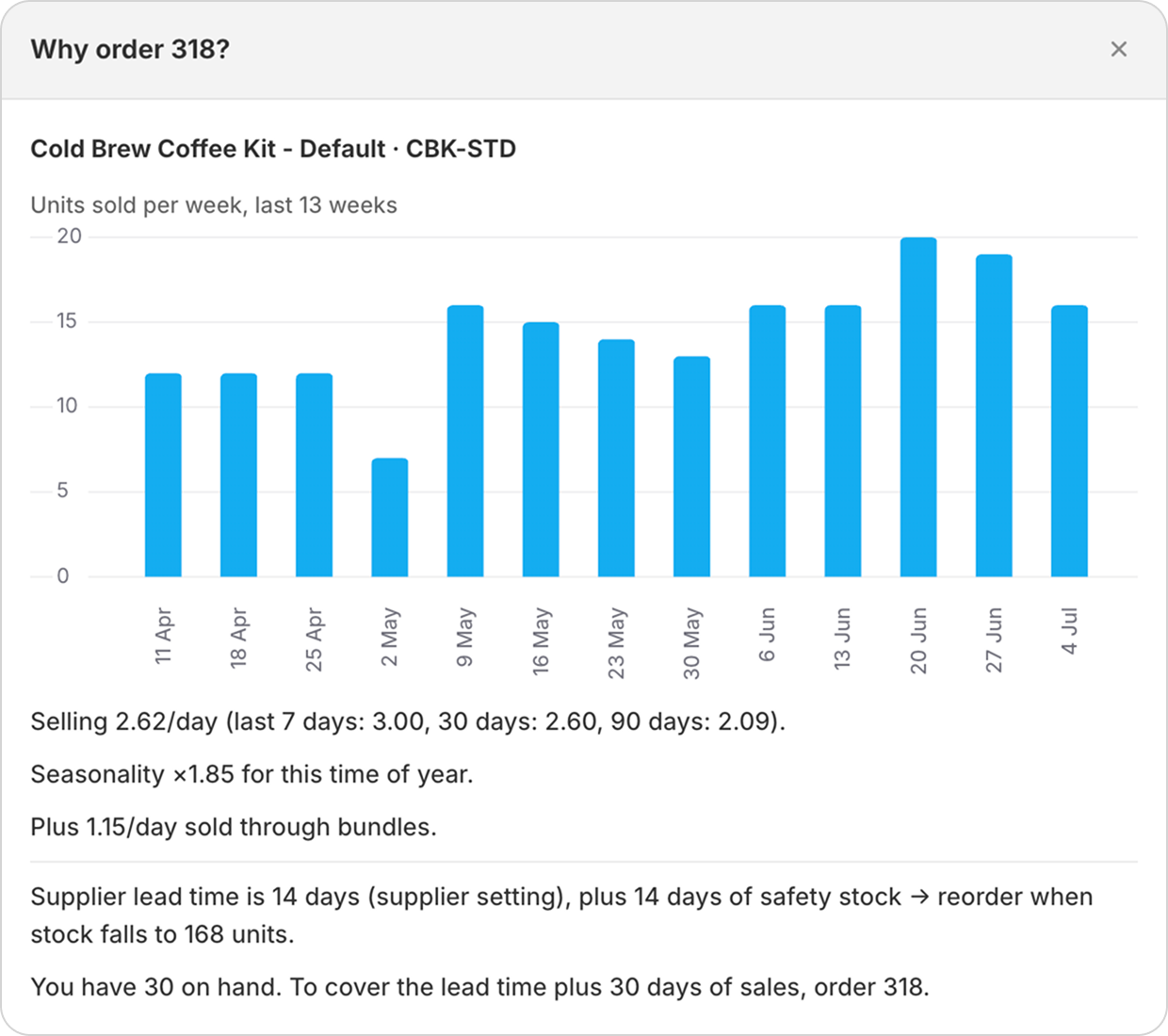
Every recommendation opens up to show the arithmetic that produced it: average demand, lead time, safety stock, units already incoming, and the order quantity that falls out of them. If you disagree with the number, you can see which input to argue with. That is the one thing I would not trade for more features.
Select the lines, and Proviand groups them into one purchase order per supplier and emails it out. The order then exists as a record with a supplier and an expected date, and its units count as incoming, so next week's forecast already knows about them. When the pallet lands you receive against the order, short deliveries included, and the stock is written into Shopify.
Criteria you can check against your own store this afternoon, not adjectives:
If more than two of those bullets describe you, install Prediko and stop reading. Proviand is built for the store where one person does the buying, the catalogue fits in the low thousands, and the failure mode is not bad analysis but a reorder that was placed twice or three weeks late. If that is a third of your job rather than the whole of it, the small surface area is a gap and not a feature.
Do not decide on a feature table. Prediko gives you 14 days; Proviand's free plan has no time limit and no card, and it reads the order history already in your store, so the buying table is populated the same afternoon. Install one or both and wait until the next time you actually have to place an order.
Then count two things. How many minutes passed between opening the recommendation and the order being sent, and how many times you had to write a number down somewhere outside the app. Whichever app wins that count is the one that fits your stage.
Not sure which fits? Email [email protected] with your annual revenue, how many SKUs you carry, and whether you hold components. If the answer is Prediko I will tell you.