I am not going to tell you Proviand is a better inventory app than Fabrikatör, because for a lot of stores it plainly is not. Fabrikatör has been on the Shopify App Store since September 2020, holds 4.8 stars from 105 reviews, and merchants describe it doing exactly the job it says it does. What it also has is a price floor of $99 a month and a feature set built for stores buying at volume. This page is about which side of that line your store sits on.
Written 26 August 2026. Every claim below about Fabrikatör was checked that day against its Shopify App Store listing, its public review pages and its own pricing page at fabrikator.io. Both companies change their pricing; check the current numbers yourself before you decide anything. Note the spelling: the product is Fabrikatör, with an umlaut, though most people search for it as Fabrikator.
This is the awkward paragraph, so I will get it out of the way first. The compliments Fabrikatör collects are the exact compliments Proviand is trying to earn.
Read the reviews and the same themes repeat. Purchase orders are described as effortless. One merchant in October 2025 wrote that it cut ordering time from hours to minutes. Others say the layout is obvious enough that they were productive without a training call, and that the forecasting is accurate enough that they stopped babysitting it. Support is praised repeatedly and specifically, which in this category is rarer than good software. Ninety-seven percent of those 105 reviews are five stars.
Fast time to value, purchase orders that do not fight you, forecasts you can trust without checking. That is the product I am building. Fabrikatör got there first and has nearly six years of merchants confirming it.
So I am not competing on quality. I am competing on price floor and on catalogue size, and those are the only two arguments on this page.
Fabrikatör bands by your annual revenue. From its App Store listing, checked 26 August 2026:
Every tier includes unlimited SKUs and unlimited users, a 14-day trial, and the same feature set. On top of the monthly price, backorders are charged at $0.75 per order after the first 50 each month. Its own pricing page adds a 30-day money-back guarantee, roughly 20% off for paying annually, which brings the entry tier to about $79 a month billed as $950 a year, and a discount for stores under $30k monthly revenue.
One thing worth knowing: the bands on fabrikator.io and the bands on the App Store listing do not line up. The site quotes $149 at $50k to $200k monthly sales and $350 at $200k to $400k, then goes quote-only above that. If your revenue is near a boundary, ask them what you will actually pay rather than working it out from a table.
Proviand bands by SKU count instead, and does not charge per anything:
The comparison that matters is the bottom of each range, not the top. Proviand's most expensive plan costs what Fabrikatör's cheapest plan costs. If you run 800 SKUs and do $400k a year, Fabrikatör is $99 a month and Proviand is $29, and the extra $70 buys you backorders, bundle planning and multi-warehouse. If you will use those, $70 is nothing. If you will not, you are paying $840 a year for a heavier tool than the job needs.
Run it the other way and Fabrikatör wins on the same arithmetic. A store with 15,000 SKUs doing $300k a year pays $99 flat there, because SKUs are free, and $99 here on Plus. Large catalogue, small revenue is the shape where revenue banding is simply the better deal, and no amount of writing on my own website changes that.
Fabrikatör's $99 covers demand forecasting at SKU level, purchase orders with supplier cost and lead time tracking, inventory reports, multi-warehouse support, bundle planning, and a backorder and pre-order engine. It integrates with Klaviyo, QuickBooks, Xero, ShipHero and Katana.
The honest test is whether you will use the half of that list Proviand does not have.
Ask yourself three questions with your own store in front of you. Do you sell things you do not currently have, and want the money and the customer either way? That is the backorder engine, and the single strongest reason on this page to choose Fabrikatör. Do you sell bundles or kits whose components you buy separately, so ordering one thing means ordering three? That is bundle planning. Do you hold stock in more than one warehouse and need the plan to know that?
Three yeses and you should install Fabrikatör today. Three noes and you are being charged for a category of work your store does not do.
Straight list, no softening.
Proviand has no backorder or pre-order engine. It will tell you that you are going to run out. It will not sell the item while you are out, capture the order, or manage the queue when stock lands. That is Fabrikatör's, and it is the capability I get asked about most.
Proviand has no bundle or component planning. If a SKU is made of other SKUs, Proviand cannot see the relationship and will forecast the parent and the components as unrelated products. Fabrikatör models it.
Beyond those two: no stock transfers between locations, no stock takes or barcode labelling, no multi-store support, no public API, no report builder, no approval workflow, and no accounting, email or 3PL integrations. It reads Shopify and nothing else. There is one person here, so there is no dedicated account manager and no data migration service.
It also launched this summer and has essentially no review history, against Fabrikatör's six years and 105 reviews. That is a real risk and you should price it in rather than take my word for the rest of this page.
One buying table. Every row is a product with a recommended order quantity.
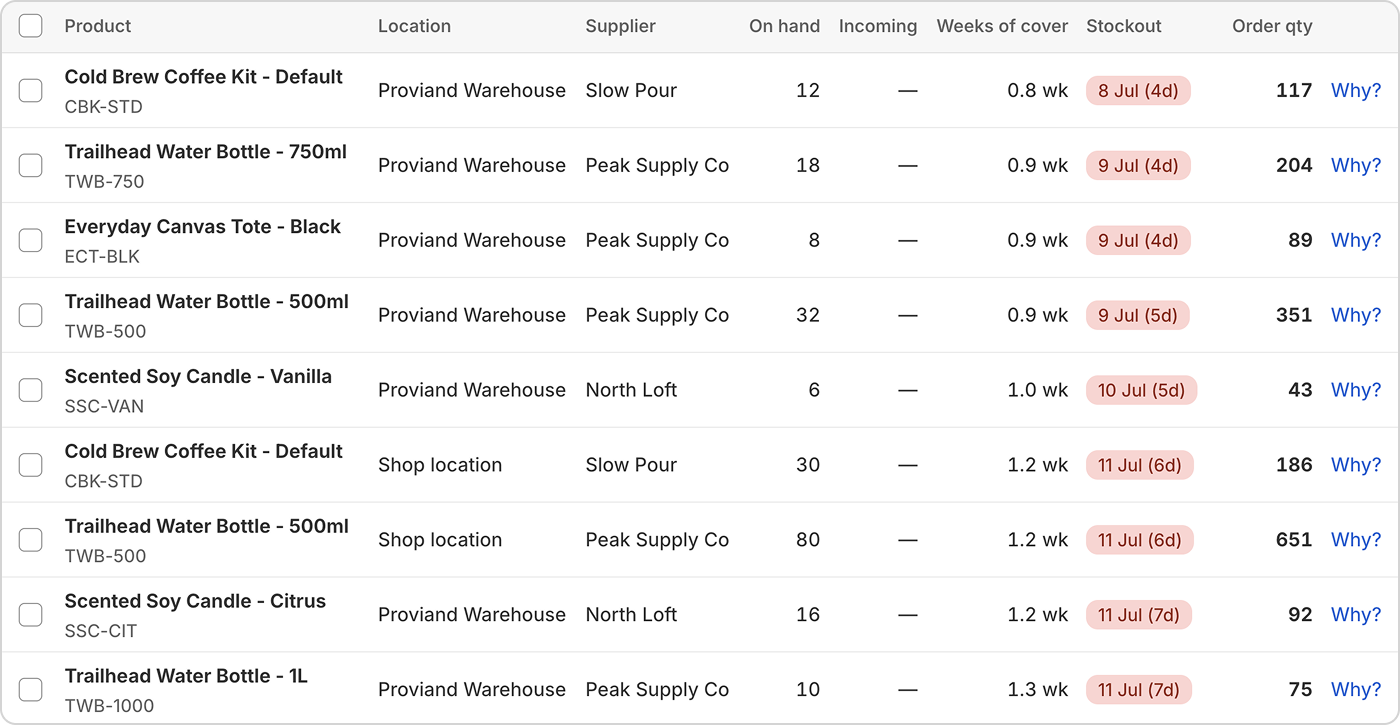
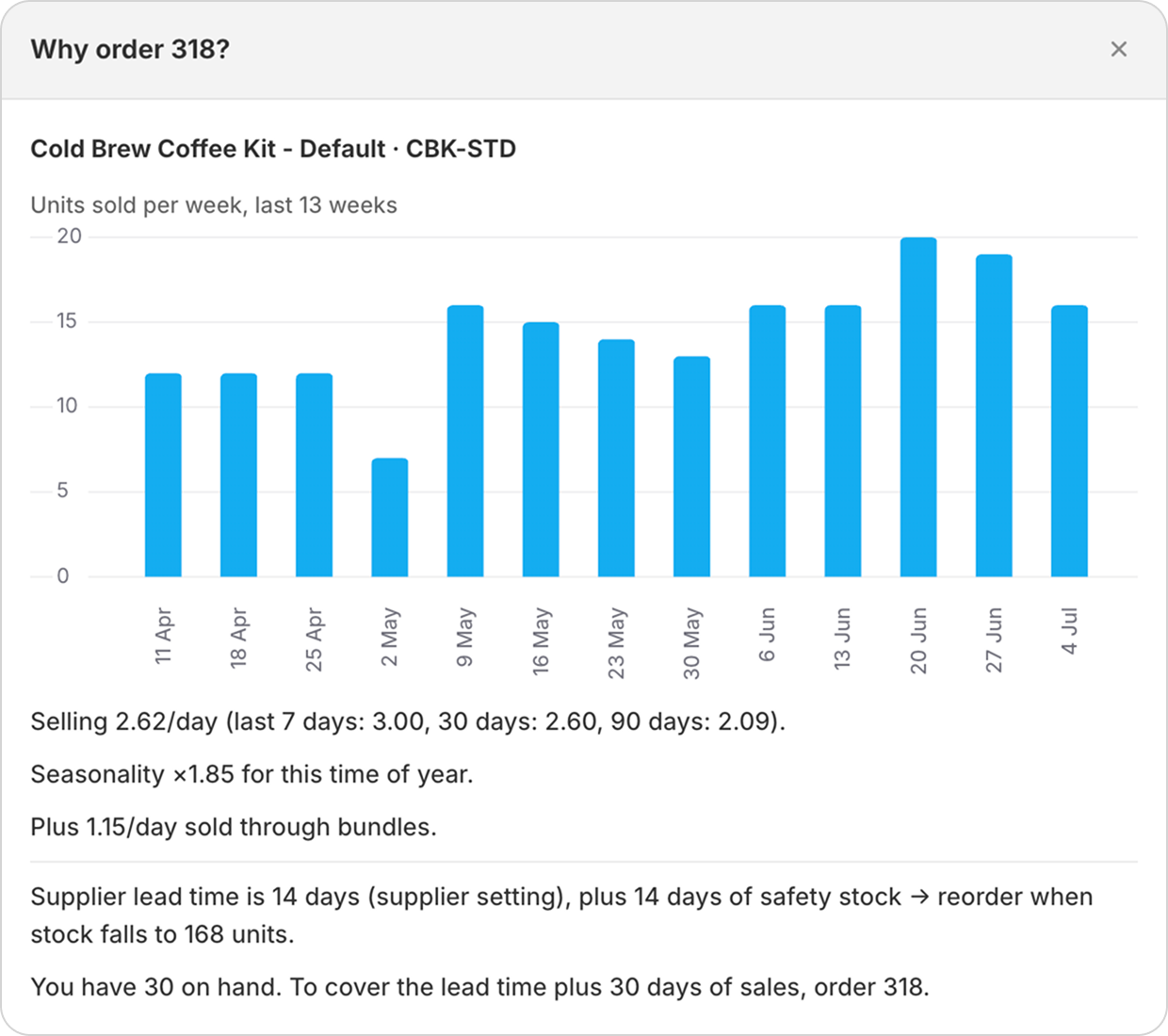
Every recommendation opens up to show the arithmetic that produced it: average demand, lead time, safety stock, units already incoming, and the order quantity that falls out of them. If you disagree with the number, you can see which input to argue with.
Select the lines, and Proviand groups them into one purchase order per supplier and emails it out. The order exists as a record with a supplier and an expected date, and its units count as incoming, so next week's forecast already knows about them. When the pallet lands you receive against the order, short deliveries included, and the stock is written into Shopify.
That is the whole product. The argument for it is that it costs $0 to find out whether it is enough.
Criteria you can check against your own store this afternoon, not adjectives:
One caveat in the other direction, for fairness: the only pattern I can find in Fabrikatör's small handful of negative reviews concerns the pre-order feature and how long a fix took, in May 2026. Two one-star reviews out of 105 is not a trend, and I am not going to pretend it is. But if backorders are the reason you are choosing them, trial that specific feature properly rather than assuming it.
If more than two of those bullets describe you, install Fabrikatör and stop reading. Proviand is built for a narrower store: one person does the buying, the catalogue is in the hundreds or low thousands, everything sits in one place, and the failure mode is not weak analysis but a reorder placed twice or three weeks late. If buying is a genuine planning function at your company rather than a Monday task, the small surface area here is a gap and not a feature.
Do not decide on a feature table, including this one. Fabrikatör gives you 14 days and a 30-day money-back guarantee, which is a fair offer. Proviand's free plan has no time limit and no card, and it reads the order history already in your store, so the buying table is populated the same afternoon.
Install one or both and wait until the next time you actually have to place an order. Then count two things: how many minutes passed between opening the recommendation and the order being sent, and how many times you had to write a number down somewhere outside the app. Whichever app wins that count is the one that fits your stage. If it is the $99 one, it was worth $99.
Not sure which fits? Email [email protected] with how many SKUs you carry, whether you sell bundles, and whether you want to take orders while out of stock. If the answer is Fabrikatör I will tell you.